Georgia Tenant Rights: What to Do About Mold in Your Rental
Georgia tenant law does not include the word "mold" in its statutes. That single fact creates confusion for thousands of renters who discover mold in their apartments or rental homes and do not know what rights they have — or whether they have any at all. The answer is more nuanced than a simple yes or no, and understanding the legal framework is the first step to getting the problem resolved.
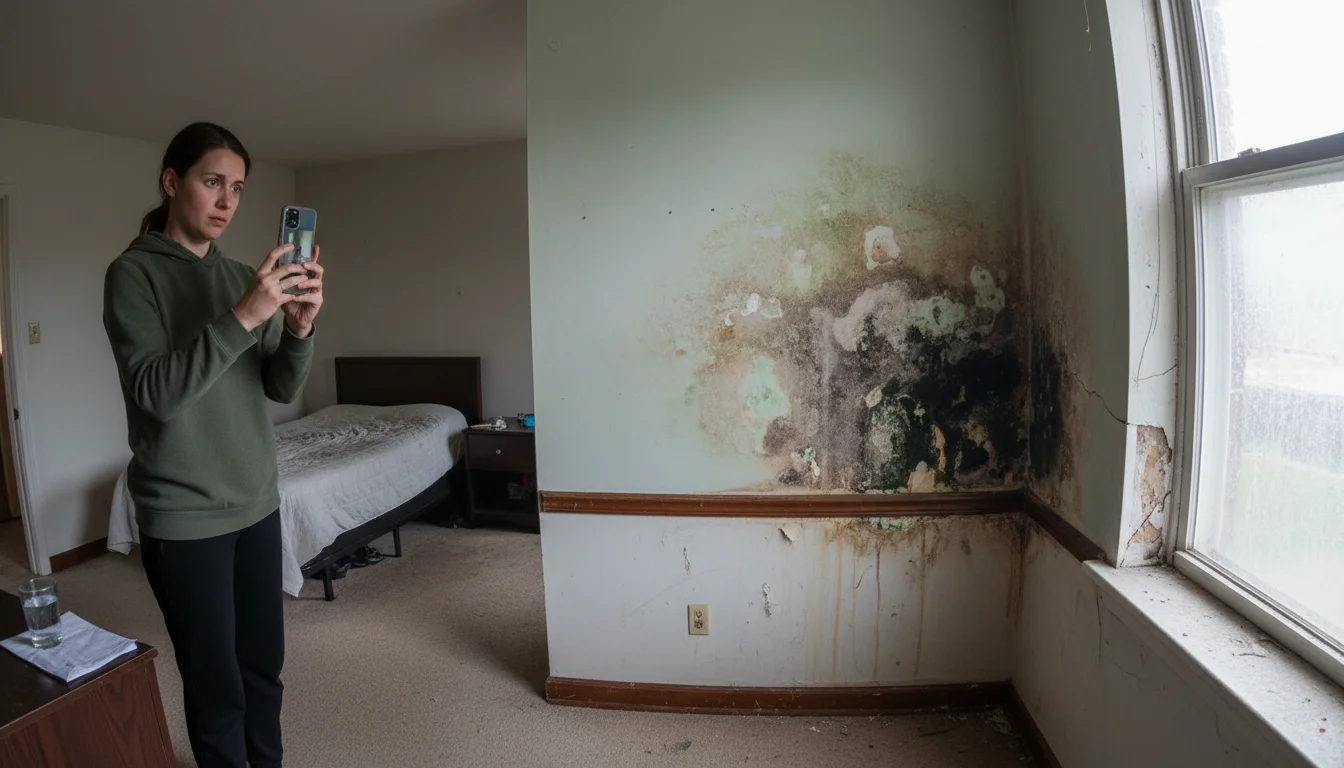
The Reality: Georgia Has No Specific Mold Law
Unlike some states — such as California, which enacted the Toxic Mold Protection Act, or Florida, which has mold-specific landlord obligations — Georgia has not passed legislation that directly addresses mold in rental properties. There is no Georgia statute that says "landlords must remediate mold within X days" or "tenants may withhold rent if mold is present." This absence of a dedicated mold law is the single biggest source of tenant frustration and confusion.
However, the lack of a specific mold statute does not mean Georgia tenants are powerless. Mold issues in rental properties fall under broader legal principles that do provide tenants with pathways to action — namely, the implied warranty of habitability under Georgia landlord-tenant law.
The Legal Framework: OCGA Title 44, Chapter 7
Georgia's landlord-tenant relationship is governed primarily by Title 44, Chapter 7 of the Official Code of Georgia Annotated (OCGA). Within this framework, two key legal concepts apply to mold situations:
The Implied Warranty of Habitability
Under Georgia case law, every residential lease carries an implied warranty of habitability — the landlord's obligation to keep the rental unit in a condition that is fit for human habitation. This warranty is not explicitly stated in most leases; it is "implied" by law as a baseline standard. A rental unit with uncontrolled mold — particularly if it causes health problems or makes portions of the unit unusable — may violate this implied warranty.
OCGA § 44-7-13 requires landlords to "keep the premises in repair." While this statute is brief and does not itemize specific conditions, Georgia courts have interpreted it to require that landlords maintain the structural integrity, plumbing, heating, and electrical systems — and to address conditions that render the unit unsafe or unsanitary. Mold resulting from a structural defect the landlord failed to repair (such as a leaking roof or failed plumbing) falls under this obligation more clearly than mold caused by tenant behavior (such as never running the bathroom fan).
Repair Obligations and Constructive Eviction
OCGA § 44-7-13 also provides a limited repair-and-deduct remedy: if the landlord fails to make necessary repairs after being notified in writing, the tenant may, under certain conditions, have the repair made and deduct the cost from rent — up to one month's rent. However, this remedy carries significant legal risk if not executed properly, and it has never been specifically tested in Georgia appellate courts for mold cases. Tenants considering this option should consult an attorney first.
Constructive eviction — the legal doctrine that a landlord has effectively evicted you by allowing the property to become uninhabitable — is another potential remedy under Georgia law. If the mold is severe enough that you cannot safely live in the unit, and the landlord has been notified and failed to act, you may have grounds to break the lease without penalty. This is a fact-intensive legal argument and, again, should be pursued with legal counsel.
Step-by-Step: What to Do If You Find Mold in Your Georgia Rental
Step 1: Document the Mold Immediately
Before you call the landlord, document everything. Take clear, well-lit photographs and videos of the mold. Include wide shots that show the location and context (which room, which wall) and close-ups that show the texture and extent of the growth. Use a ruler or a dollar bill for scale in at least one photo. Note the date you discovered the mold and any conditions that may have caused it — such as a ceiling stain indicating a roof leak, a wet spot on the floor, or condensation on windows.
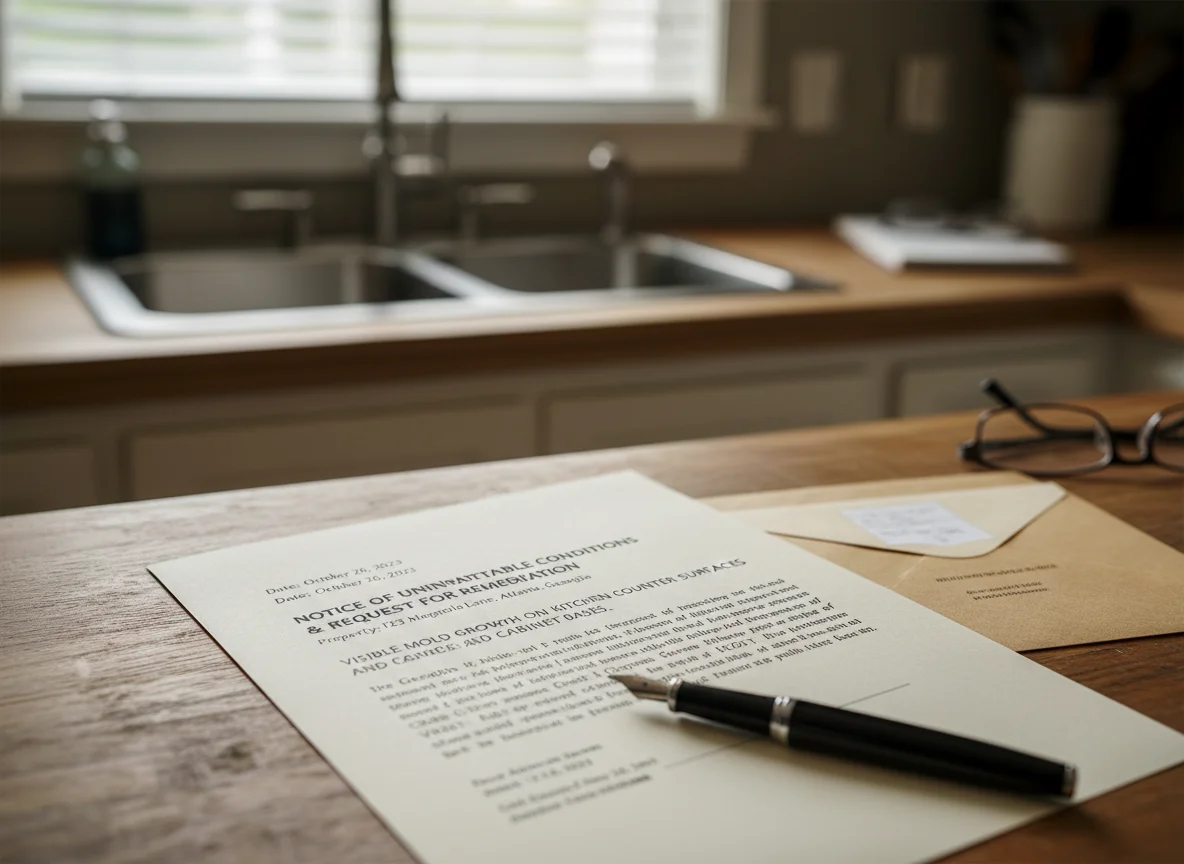
If you or a family member have experienced health symptoms (respiratory issues, allergies, headaches) that you believe are related to the mold, document those symptoms with dates and, ideally, a doctor's visit. Medical records linking your symptoms to the mold are among the strongest evidence you can present if the situation escalates to legal action.
Step 2: Notify the Landlord in Writing
Under Georgia law, the landlord must be given notice and a reasonable opportunity to make repairs. A verbal phone call is not sufficient to protect your rights. You need a dated, written notice delivered in a way that creates a record — certified mail with return receipt requested is the gold standard, but a dated email with read receipts enabled is also effective for creating a paper trail.
Your written notice should: describe the mold (location, approximate size, how long you have been aware of it), note any health symptoms the household has experienced, specify the condition you believe is causing the mold (if known), request a specific remedy (inspection and remediation by a licensed contractor), and set a reasonable deadline for response — typically 7 to 14 days depending on severity.
Sample Notification Letter
[Your Name]
[Your Address, including apartment/unit number]
[City, State, ZIP]
[Date]
[Landlord or Property Manager Name]
[Management Company or Landlord Address]
[City, State, ZIP]
Re: Mold Condition at [Your Rental Address] — Request for Repair
Dear [Landlord/Manager Name],
I am writing to notify you of a mold condition in my rental unit at [full address]. On [date], I discovered visible mold growth on [describe specific location: e.g., "the bedroom ceiling near the west-facing window" or "the bathroom wall behind the toilet"]. The affected area is approximately [size estimate]. I have attached photographs taken on [date] for your reference.
I believe the moisture source may be [describe if known: e.g., "a roof leak that has been dripping during recent rains" or "a persistent plumbing leak under the bathroom sink"]. Member(s) of my household have experienced [describe any health symptoms, if applicable].
Under OCGA § 44-7-13 and the implied warranty of habitability, I am requesting that you arrange for a professional mold inspection and, if remediation is needed, that it be performed by a licensed contractor at your earliest convenience. Please respond in writing within [7 or 14] days with a plan to address this condition.
I value our landlord-tenant relationship and want to resolve this matter cooperatively. Please contact me at [your phone number] or [your email] to discuss next steps.
Sincerely,
[Your Signature]
[Your Printed Name]
Step 3: Allow Reasonable Time for the Landlord to Respond
Georgia law does not define a specific number of days that constitutes "reasonable time" for a landlord to begin repairs. What is "reasonable" depends on the severity of the problem, the complexity of the repair, and the time of year. A ceiling leak during a rainy week may need immediate tarping but may require drier weather for a permanent roof repair, for example. Most judges would consider a delay of more than 30 days without action to be presumptively unreasonable for a mold condition that affects habitability — especially if there are associated health symptoms.
During this period, keep a log of all communications with the landlord: dates of phone calls, summaries of conversations, copies of texts and emails. If the landlord sends a maintenance person who sprays bleach on the mold and leaves without addressing the moisture source, document that too — because surface cleaning without moisture correction is not remediation, and the mold will return. For more on what legitimate remediation looks like, see our mold inspection vs. testing guide.
Step 4: Escalate If the Landlord Does Not Act
If your landlord does not respond within a reasonable period or refuses to address the mold, you have several options — each with varying levels of legal complexity and risk:
- Contact local code enforcement: The City of Gainesville Code Enforcement Division or Hall County Code Enforcement can inspect the property for building code violations that may be causing the mold (e.g., a leaking roof, failed plumbing, inadequate ventilation). Code enforcement can issue citations that compel the landlord to make repairs, though the process is not particularly fast. This is a free and relatively low-risk step.
- Repair and deduct (use with caution): Under OCGA § 44-7-13, you may have the right to hire a contractor to fix the problem and deduct the cost from your rent, up to one month's rent. This remedy has strict requirements and carries risk — if a judge later determines the repair was not legally justified, you could be evicted for nonpayment. Consult an attorney before exercising this option.
- Constructive eviction and lease termination: If the mold renders the unit uninhabitable and the landlord refuses to act, you may have grounds to break the lease without penalty. This requires documenting that you notified the landlord, gave reasonable time, and then vacated because the condition made continued occupancy unsafe. It is strongly recommended to have an attorney review your situation before taking this step.
- Legal action: You can sue the landlord in Hall County Magistrate Court (small claims division) for damages — including medical costs, property damage (moldy furniture, clothing), and relocation expenses. The jurisdictional limit for Magistrate Court in Georgia is $15,000. You can also file a complaint with the Georgia Attorney General's Consumer Protection Division if the landlord's conduct constitutes an unfair or deceptive trade practice.
Special Considerations for Gainesville and Hall County Renters
Older Rental Stock
Much of Gainesville's rental housing inventory — particularly duplexes, converted single-family homes, and older apartment complexes near downtown and the New Holland area — was built before 1990. These properties are more likely to have aging plumbing, older roofs, inadequate crawlspace vapor barriers, and poorly sealed building envelopes — all risk factors for mold. If you are renting an older property in Hall County, be especially vigilant about the signs of hidden mold and report moisture issues promptly.
Lake Lanier Proximity
Rental properties near Lake Lanier face the same elevated ambient humidity discussed in our Georgia humidity guide. If you rent a home or apartment within a mile of the lake, running a dehumidifier during warm months is not optional — it is a necessity. Unfortunately, many rental units do not include dehumidifiers, and tenants are left with interior humidity levels routinely above 65%, creating conditions for mold on exterior walls and in closets.
Hall County Magistrate Court
If you need to pursue legal action, the Hall County Magistrate Court is located at 225 Green Street SE in Gainesville. Small claims cases (up to $15,000) can be filed without an attorney, though consulting one beforehand is wise. The Hall County Clerk of Court website provides forms and filing fee information. Georgia Legal Aid (GeorgiaLegalAid.org) also offers free resources and may provide representation in certain circumstances.
The Dangers of Ignoring Mold in a Rental
Some tenants — particularly those who fear retaliation from their landlord — choose to live with mold rather than raise the issue. This is a mistake for several reasons:
- Health consequences are real. Long-term exposure to elevated indoor mold spore concentrations can cause or worsen respiratory conditions, trigger asthma attacks, and produce chronic allergy symptoms. Children and the elderly are especially vulnerable.
- The problem grows. Mold does not self-resolve. The colony expands as long as moisture is present, spreading behind walls and into adjacent rooms. A small patch today becomes a major infestation — and a more contentious dispute — months later.
- You may be blamed for the spread. If you fail to report mold promptly and it spreads, the landlord may argue that you contributed to the damage through neglect of your duty to notify — potentially making you financially responsible for a portion of the remediation cost.
- Security deposit liability. At lease-end, if mold is present and you did not report it, the landlord may attempt to deduct remediation costs from your security deposit, claiming the mold was caused by tenant behavior (e.g., not using exhaust fans, not reporting leaks). Having a documented notification history protects you against this claim.
Resources for Georgia Tenants
- Georgia Legal Aid: GeorgiaLegalAid.org — Free legal information and self-help resources for low-income Georgians. Offers a landlord-tenant hotline.
- Atlanta Legal Aid Society: (404) 524-5811 — Serves the metro area but also provides statewide referrals and online resources.
- Hall County Magistrate Court: 225 Green Street SE, Gainesville, GA 30501. Filing small claims up to $15,000.
- City of Gainesville Code Enforcement: (770) 531-6570 — For building code and property maintenance complaints within Gainesville city limits.
- Hall County Code Enforcement: (770) 531-6807 — For properties in unincorporated Hall County.
- Georgia Department of Community Health — Indoor Air Quality Program: Provides educational resources on mold and indoor environmental health concerns.
If you are a tenant in Hall County and your landlord has agreed to remediate the mold, Mold Remediation Hotline works directly with property owners throughout North Georgia. We are also available to speak with tenants who need to understand what proper remediation entails, so you can evaluate whether your landlord's response is adequate.
Landlord Agreed to Remediate? We Can Help
Call Mold Remediation Hotline at (332) 220-0303 if your Hall County landlord needs a professional mold inspection and remediation estimate. We work with property owners and management companies throughout North Georgia.