How to Avoid Mold Remediation Scams: A Georgia Homeowner's Guide
Finding mold in your home is stressful enough. Unfortunately, a small number of dishonest contractors exploit that stress — using high-pressure sales tactics, inflated scare stories, and phony credentials to extract money from worried homeowners. Here are seven red flags to watch for when hiring a mold remediation company in Georgia, plus what an honest contractor looks like.
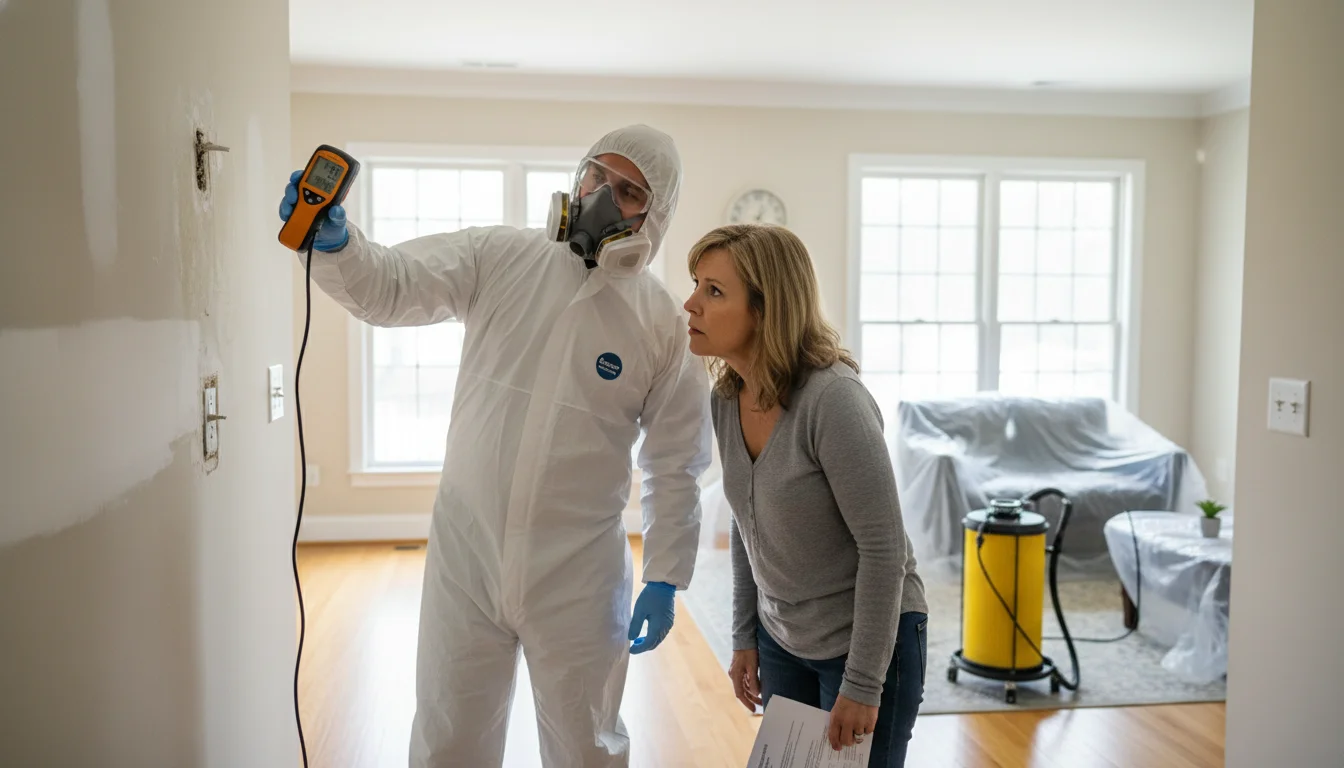
Red Flag #1: High-Pressure Sales Tactics and "Act Now" Demands
A legitimate mold remediation company understands that hiring a contractor is a significant decision. They will give you time to review their estimate, check references, and make an informed choice. Scam operators do the opposite: they pressure you to sign a contract on the spot, claiming that "mold doubles every 24 hours" or "your family is in immediate danger" if you wait even a day.
While it is true that mold can spread under continuously wet conditions, a colony that has been present for weeks or months is not going to transform your home overnight if you take two days to compare estimates. Any contractor who tries to frighten you into an immediate commitment — particularly with language about "toxic black mold" before any testing has been done — should be shown the door. Honest companies provide information and let the homeowner decide.
Red Flag #2: No Written, Itemized Estimate
A reputable mold remediation contractor provides a detailed, written estimate that breaks down every component of the job. You should see line items for containment setup, demolition and disposal, HEPA vacuuming and air scrubbing, antimicrobial treatment, drying equipment, and post-remediation verification. The estimate should specify the square footage being treated, the materials being removed and replaced, and the projected timeline.
Scam operators often provide vague one-line quotes — "mold removal, $6,500" — with no explanation of what that money actually covers. This leaves them free to add surprise charges later ("We had to remove more drywall than expected, that'll be another $3,000") or to skip essential steps while charging for them. A verbal estimate is not an estimate; it is a sales pitch. Always insist on a written, itemized quote before authorizing any work.
Red Flag #3: No License, No Insurance, No References
In Georgia, mold remediation contractors are regulated at the state level. Legitimate mold assessors and remediators should carry appropriate licensing, and they should be happy to provide their license number when asked. They should also carry both general liability insurance and workers' compensation insurance — and be willing to provide certificates of insurance naming you as the certificate holder.

Ask for three recent references from jobs similar to yours. A legitimate company will provide them — among the traits of the best mold removal companies in Gainesville. A scam operator will have excuses ready — "privacy concerns," "every job is different," or vague claims about "hundreds of satisfied customers" with no specific names. Taking 10 minutes to call a reference and ask "Was the job completed on time? On budget? Did anything surprise you?" can save you from a five-figure disaster.
Red Flag #4: The Same Company Performs Testing AND Remediation
This is one of the most important conflict-of-interest issues in the mold industry. A company that both tests for mold (identifying its type and extent) and performs the remediation has a powerful financial incentive to find problems — and to declare them "solved" once they have been paid. For this reason, many industry standards, including the IICRC S520 guidelines widely referenced in Georgia, recommend that mold assessment and mold remediation be performed by independent parties.
At Mold Remediation Hotline, we are a remediation company. We do not perform laboratory mold testing or air sampling that would create a conflict of interest. If your situation requires lab analysis — for identification of mold species, post-remediation clearance testing, or documentation for an insurance claim or legal matter — we recommend you hire an independent indoor environmental professional (IEP) who works only on a testing basis. That separation protects you.
Red Flag #5: Suspiciously Low Quotes
If one estimate comes in at $800 for a job that three other contractors quoted at $3,500 to $5,000, the low bid is not a bargain — it is a warning. Proper mold remediation requires expensive equipment (negative air machines, commercial HEPA air scrubbers, personal protective equipment), licensed labor, proper disposal procedures, and adequate time. A contractor who undercuts the market by 70% or more is almost certainly cutting corners.
Common shortcuts include: spraying bleach on visible mold and calling it done (bleach does not penetrate porous materials and may actually increase moisture on surfaces like drywall), skipping containment entirely and spreading spores throughout the house, using residential-grade air purifiers instead of commercial HEPA units, or "remediating" a crawlspace without addressing the standing water that caused the mold. A cheap remediation job that fails in three months is far more expensive than a properly priced job done once.
Red Flag #6: Fear-Mongering About "Toxic Black Mold" Without Testing
The term "toxic black mold" is a media invention, not a scientific classification. While Stachybotrys chartarum (one species of dark-colored mold) can produce mycotoxins under certain conditions, the presence of black-colored mold does not automatically mean the mold is Stachybotrys — let alone that it is actively producing mycotoxins at harmful levels. There are thousands of dark-colored mold species, most of which are allergenic but not "toxic" in the dramatic sense that scam artists invoke.
An honest contractor will tell you the following: all indoor mold growth is undesirable and should be removed regardless of species, the health risk from mold is primarily allergic or respiratory irritation, and mold color alone is not a reliable indicator of danger. A scam operator will point at a dark spot on your wall and start talking about neurological damage, memory loss, and "sick building syndrome" before any sample has been taken. Fear sells — and honest companies do not use it as a sales tool.
Red Flag #7: Unmarked Vehicles, No Physical Address, Cash-Only Demands
A legitimate contracting business has a physical office, a registered business address, branded vehicles or at least clearly identifiable professional transport, and accepts standard forms of payment. Scam operators often operate out of a PO box (or no listed address at all), drive an unmarked personal vehicle, and may demand cash payment or large upfront deposits before any work is performed.
Check the company's presence online. Look for a real Georgia business registration, a physical address you can verify on a map, a working phone number answered by a real person, and at least some online history — reviews, a website, or mentions in local business directories. A mold remediation company that appeared from nowhere last week with no digital footprint is a risk you do not need to take.
What Georgia Homeowners Should Know About Licensing
Georgia does not have a standalone "mold remediation license" in the way some states do. However, mold remediation often falls under the scope of general contractor licensing when the work involves structural repairs or alterations. Many reputable mold remediation companies in Georgia hold IICRC (Institute of Inspection, Cleaning, and Restoration Certification) credentials — specifically the Applied Microbial Remediation Technician (AMRT) or Water Restoration Technician (WRT) certifications — which demonstrate training in industry-standard protocols.
When evaluating a contractor, ask: "Do you follow IICRC S520 guidelines for mold remediation?" A professional will know what that standard is and answer yes. A novice or scammer will look confused. Also ask about their liability insurance specifically for mold-related work — standard general liability policies sometimes exclude mold claims, and a serious mold remediation company will carry coverage that specifically includes microbial work.
Why Mold Remediation Hotline Does Things Differently
We believe transparency is the foundation of trust. Here is exactly how we operate with every Hall County homeowner:
- Free, written estimates — always. We come to your property, inspect thoroughly, and hand you a detailed, itemized estimate. No phone quotes, no pressure, no obligation. Take as long as you need to review it.
- We remediate; we do not test. If lab testing is warranted, we recommend you hire an independent IEP. We will not profit from telling you what kind of mold you have, because we believe the conflict of interest is too great.
- We explain everything in plain English. You will know exactly what we plan to do, why we plan to do it, how long it will take, and what it will cost — with no jargon, no scare tactics, and no surprises.
- We carry full insurance. Our general liability and workers' compensation policies are current, and we will provide certificates upon request.
- We serve all of Hall County and North Georgia. Gainesville, Oakwood, Flowery Branch, Buford, Braselton, Lula, Clermont, Murrayville — we are local and we are accountable to this community.
For more on what professional remediation actually costs in our area, see our Gainesville mold removal cost guide. And if you have spotted any of the signs of mold in your home, an honest mold inspection is your first step.
Get an Honest, Transparent Mold Estimate in Hall County
Call Mold Remediation Hotline at (332) 220-0303 for a free, no-obligation inspection and detailed written estimate. Licensed, insured, and committed to fair pricing — no scare tactics, ever.