Mold After Water Damage: Your Gainesville Restoration Timeline
Water invades your home at 2 a.m. on a Tuesday — a burst supply line, a roof leak during a Hall County thunderstorm, or Lake Lanier floodwater seeping into your crawlspace. Within 24 to 48 hours, invisible mold spores floating in every home's air begin germinating on wet drywall, carpet padding, and wood framing. Wait one week, and you have visible colonies. Wait three weeks, and structural remediation costs can quadruple. Here's exactly how the clock runs after water damage in Gainesville, Georgia — and the step-by-step actions that save your home and your health.
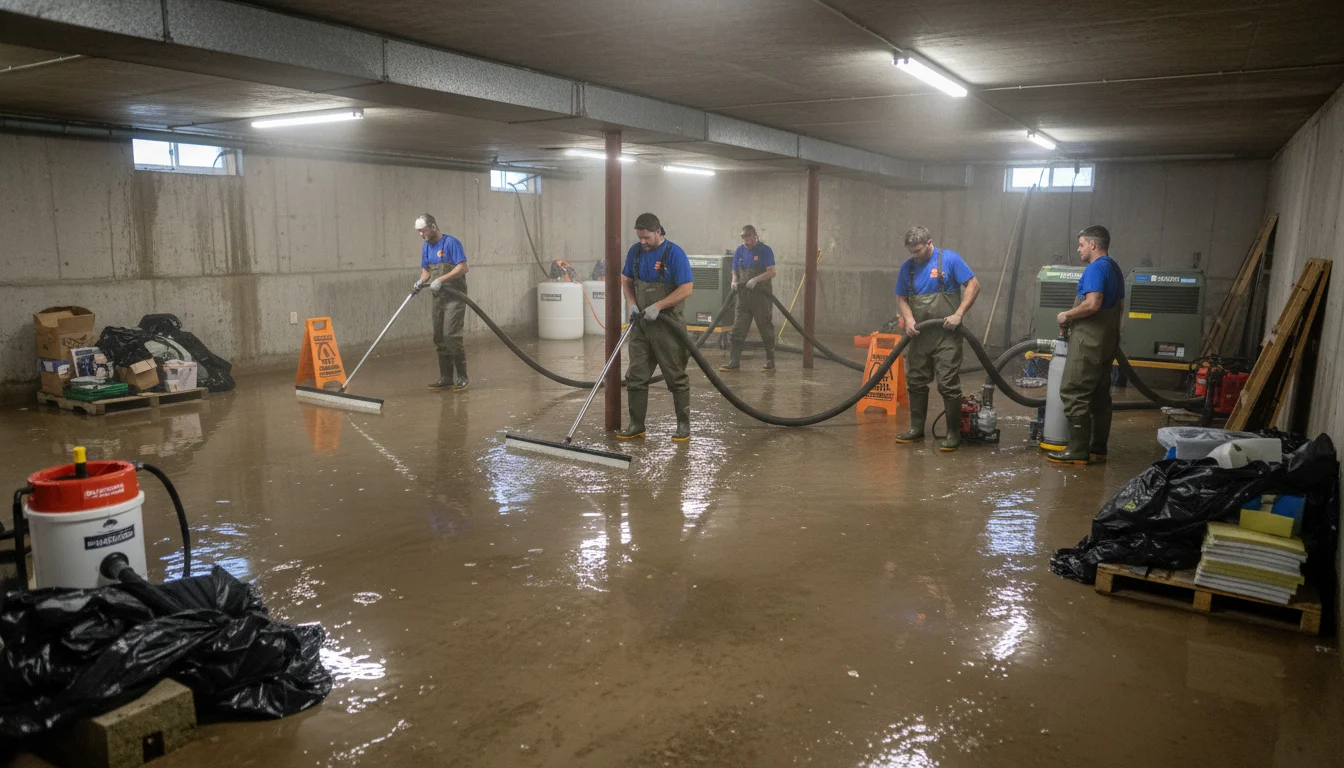
Why Gainesville Homeowners Face an Accelerated Mold Timeline
Before we walk through the day-by-day progression, understand this: Georgia's climate compresses every timeline you'll read on generic water-damage articles written for Arizona or Colorado. Hall County sits in ASHRAE Climate Zone 3A — warm and humid. Between May and September, Gainesville's average relative humidity hovers between 70% and 85%. Outdoor dew points routinely exceed 70°F. What that means practically: the ambient moisture load inside a water-damaged Gainesville home is dramatically higher than a home in Denver or Phoenix. Mold spores that might take 72 hours to germinate in a dry climate can activate in under 18 hours here.
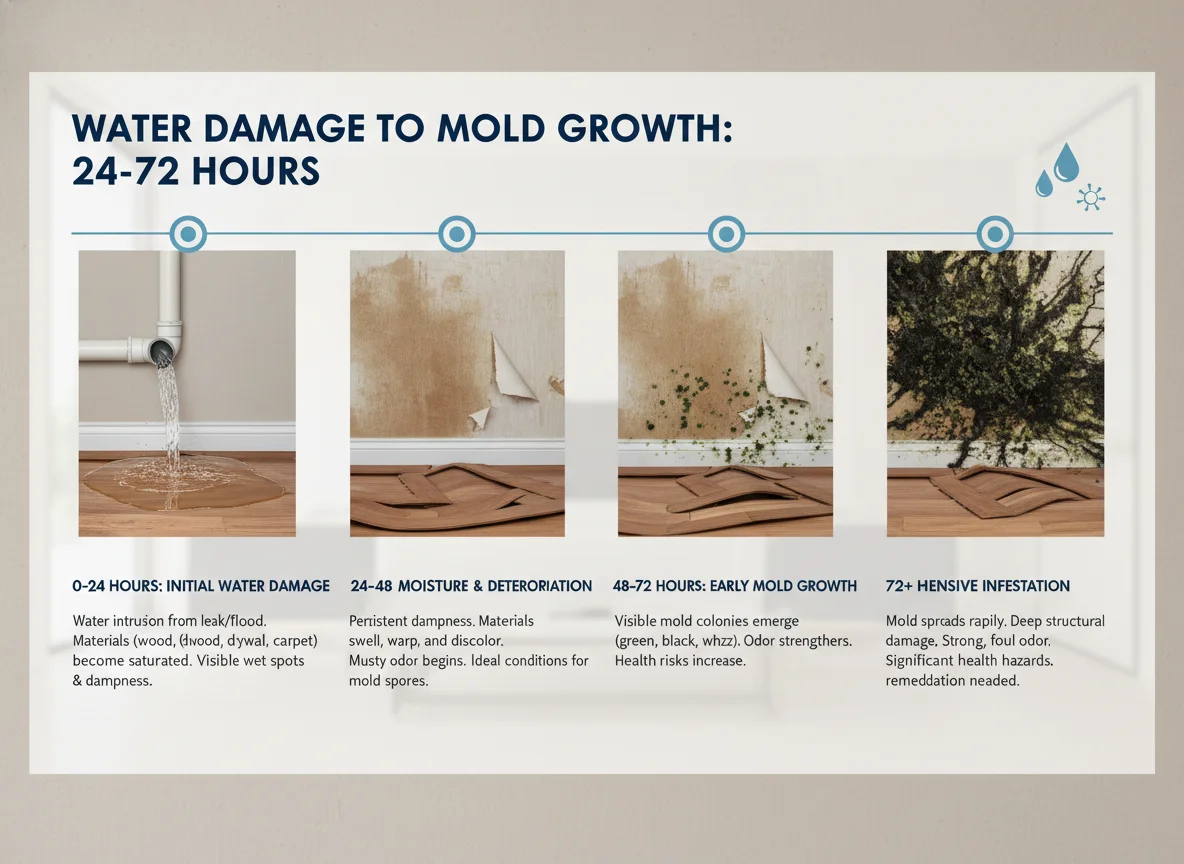
According to the EPA, mold begins growing on wet cellulose surfaces (drywall paper, wood, carpet backing) within 24 to 48 hours of water exposure. In North Georgia's June-through-September conditions, we consistently see visible growth appearing at the 36-hour mark rather than the 48-hour mark quoted nationally. The Georgia Department of Public Health's indoor air quality guidance reflects this — they recommend initiating drying within 24 hours in our climate zone, not the 48-hour window cited in milder regions.
The Water Damage Mold Timeline: Stage by Stage
Hour 0 to Hour 12: The Opportunity Window
What's happening: Water has saturated porous materials. Mold spores present in every cubic foot of indoor air have landed on wet surfaces but have not yet germinated. The water is clean (Category 1) if it came from a supply line or rainwater. If it came from a washing machine overflow, dishwasher discharge, or toilet overflow without feces, it's Category 2 (gray water). If it's sewage backup or floodwater from Lake Lanier overflow, it's Category 3 (black water) — an immediate biohazard.
Your action plan, right now:
- Stop the water source. Shut off the main valve if you can't isolate the leak. Know where your shutoff is before you need it.
- Cut electrical power to affected areas. Water and electricity are a lethal combination. Flip breakers for any room with standing water.
- Call a water damage restoration company serving Gainesville immediately. Every hour of delay after Hour 12 increases remediation complexity and cost. Mold Remediation Hotline at (332) 220-0303 can dispatch a crew to your Hall County property within hours.
- Remove standing water with a wet/dry shop vacuum if the quantity is manageable and the water is Category 1. For anything deeper than a quarter-inch across more than a single room, or any gray/black water, wait for professionals.
- Move furniture and belongings out of affected areas. Wood furniture legs wick moisture upward within hours.
- Document everything. Photograph standing water, wet drywall, water lines on walls. Your insurance adjuster needs this.
Hour 12 to Hour 24: Spore Activation Begins
What's happening: Mold spores that landed on wet drywall, carpet, or wood have begun absorbing moisture and swelling. Within 18 to 24 hours under Gainesville's summer conditions, the first hyphae (root-like filaments) penetrate the surface of cellulose materials. You cannot see mold yet. You may not smell it yet. But the biological clock reached midnight.
During this window:
- Professional restoration crews should have high-volume air movers and commercial dehumidifiers running. The goal is to drop the moisture content of structural materials below 16% (wood) and below 12% (drywall) before hyphae anchor deeply.
- If you're waiting for a crew, maximize ventilation. Open windows on opposite sides of the house to create cross-flow. Run every exhaust fan you have. Set your AC to 68°F if outdoor humidity is lower than indoor humidity; otherwise, close windows and run a portable dehumidifier.
- Remove wet carpet padding. Carpet itself can sometimes be salvaged if dried quickly; padding is almost never worth saving and becomes a mold reservoir within 24 hours.
Hour 24 to Hour 48: Germination and Early Colonization
What's happening: This is the window most national guidelines reference as the "mold clock." By 36 hours, mold hyphae have formed a mycelial network on the surface layer of wet drywall paper. By 48 hours, you may detect a musty, earthy odor — the microbial volatile organic compounds (mVOCs) produced by metabolizing fungi. Under magnification, you'd see small fuzzy patches. To the naked eye, surfaces may show slight discoloration that most homeowners dismiss as "water staining."
What this means for remediation:
- Wet drywall that hasn't been dried by the 48-hour mark should be removed and replaced, not just dried in place. The paper facing of drywall is pure mold food once it's been saturated.
- Baseboards and trim should be removed. Water wicks behind them, trapping moisture against the drywall and sill plate.
- Wall cavities need inspection. If water ran down inside a wall, the insulation is wet, and the back side of the drywall is wet too. This is invisible from the room side but produces mold that releases spores into the wall cavity, which then migrate through electrical outlets into living spaces.
Day 3 to Day 5: Visible Colonies Form
What's happening: By days three through five, mold colonies become visible to the naked eye. Stachybotrys chartarum (the notorious "black mold"), Aspergillus, Penicillium, and Cladosporium are the most common species appearing after water damage in North Georgia homes. You'll see dark spotting on drywall, greenish patches on wood, and black discoloration spreading from baseboards upward.
The odor is now unmistakable. Occupants may begin experiencing symptoms: nasal congestion, throat irritation, coughing, wheezing, eye irritation. People with asthma, allergies, or compromised immune systems are affected first, but even healthy adults report headaches and fatigue after spending hours in a mold-active environment.
Remediation at this stage typically involves:
- Containment barriers (6-mil polyethylene sheeting) to isolate affected areas from the rest of the home during removal.
- Negative air pressure with HEPA-filtered air scrubbers exhausting outside.
- Removal of all visibly colonized drywall, insulation, carpet, and padding.
- HEPA vacuuming and antimicrobial treatment of remaining structural framing.
- Rapid structural drying before reconstruction begins.
Day 7 to Day 14: Significant Spread and Penetration
What's happening: After one to two weeks of unchecked moisture, mold has penetrated deep into structural materials. Drywall has lost structural integrity and crumbles to the touch. Wood framing may show surface colonization that requires sanding or media blasting to remove. Insulation inside wall cavities is fully colonized and must be bagged and removed. HVAC ductwork downstream of the affected area has likely drawn in spores, distributing them throughout the home every time the system runs.
At this point, you are no longer dealing with a cleanup; you're dealing with a partial reconstruction project. Costs increase dramatically compared to a rapid-response intervention. A $3,000 water extraction and drying job at Hour 6 becomes a $12,000-$25,000 remediation and rebuild at Day 10.
Health symptoms among occupants are now likely pronounced. The CDC notes that prolonged mold exposure is associated with upper respiratory tract symptoms, and in sensitive individuals, can trigger asthma attacks and hypersensitivity pneumonitis.
Week 3 and Beyond: Structural Damage Risk
What's happening: After three weeks of continuous moisture, not just mold but wood decay fungi become a concern. Brown rot and white rot fungi destroy the structural integrity of floor joists, wall studs, sill plates, and roof sheathing. Unlike surface mold that can be cleaned, rot-damaged wood has permanently lost compressive and tensile strength. Replacement is the only option.
Mold colonies are now sporulating heavily. Indoor spore counts can exceed 100,000 spores per cubic meter — compared to typical outdoor levels of 200-2,000 spores per cubic meter. The home may be classified as Condition 3 contamination (the most severe category in the IICRC S520 mold remediation standard), requiring full containment, full PPE for remediation crews, and comprehensive clearance testing before re-occupancy.
How Water Type Affects Your Timeline
Category 1: Clean Water
Burst supply lines, tub overflows without contaminants, rainwater through a fresh roof leak. Clean water presents the lowest immediate health risk, but the mold timeline doesn't care about water cleanliness. Clean water on drywall feeds mold just as effectively as dirty water. However, the advantage is that materials exposed only to clean water can often be dried and saved if you act within the 24-hour window. After 48 hours, clean water degrades to Category 2 anyway as it picks up contaminants from building materials.
Category 2: Gray Water
Washing machine discharge, dishwasher overflow, toilet overflow without feces, sump pump failure. Gray water contains microorganisms and nutrients that accelerate mold growth. The timeline compresses because the water itself carries organic matter that feeds mold immediately. Materials exposed to gray water should be treated with antimicrobial agents even if dried within 24 hours. Carpet padding exposed to gray water should be discarded regardless of drying time.
Category 3: Black Water
Sewage backups, toilet overflows with feces, floodwater from creeks and Lake Lanier, standing water that sat for more than 48 hours. Black water is a biohazard containing pathogenic bacteria, viruses, and parasites in addition to fueling mold. All porous materials exposed to black water must be removed and discarded — no salvage attempt. This includes drywall, insulation, carpet, padding, upholstered furniture, and mattresses. Non-porous surfaces require disinfection with an EPA-registered biocide before mold remediation even begins. This is absolutely not a DIY scenario; professional biohazard-trained crews with proper PPE are essential.
Why Hall County's Humidity Accelerates Everything
North Georgia's humidity isn't just a comfort issue — it's a mold-growth accelerant that homeowners moving from drier states consistently underestimate. Consider these Gainesville-specific factors:
- Summertime indoor humidity without AC or dehumidification routinely reaches 60-70% relative humidity. Mold thrives at 60%+ RH, and the optimal range for most indoor species is 70-90%. A home that suffered water damage in July, even after visible water is removed, provides a near-perfect mold environment without aggressive mechanical dehumidification.
- Crawlspace humidity in Hall County homes with vented crawlspaces can reach 90%+ during summer. If water damage occurs in a room above that crawlspace, moisture wicks downward into the floor assembly and meets moisture wicking upward from the crawlspace. The floor system is sandwiched between two moisture sources, dramatically accelerating rot and mold.
- Fall and winter condensation reverses the problem. When outdoor temperatures drop but indoor humidity stays elevated from showering, cooking, and breathing, condensation forms on cold surfaces — window frames, exterior walls, attic sheathing. This slow, chronic moisture source produces mold over weeks and months that homeowners often don't notice until staining appears.
Immediate Steps for Gainesville Homeowners After Water Damage
Print this checklist or save it to your phone. When water damage happens — and in Hall County, with our aging housing stock and seasonal storms, it inevitably will — follow these steps in order:
- Stop the water. Know your main shutoff location.
- Call (332) 220-0303. Mold Remediation Hotline dispatches to Gainesville, Oakwood, Flowery Branch, and all of Hall County. The sooner we arrive, the more of your home we can save.
- Photograph everything before moving anything. Insurance claims live and die on documentation.
- Remove what you can safely move — furniture, rugs, electronics, personal items — to dry areas.
- Mop or vacuum standing water if you have a wet/dry vac and the water is clean. Do not use a standard household vacuum.
- Open windows if outdoor humidity is lower than indoor humidity. In Gainesville summers, outdoor humidity is often higher — in that case, close windows, crank the AC, and run portable dehumidifiers.
- Do NOT use fans to blow air across visible mold. This spreads spores throughout the home.
- Do NOT apply bleach to mold. Bleach is effective on non-porous surfaces only; on porous materials like drywall and wood, the water in bleach feeds the mold roots deeper while the chlorine evaporates off the surface. Professional antimicrobials are required for porous materials.
Our water damage restoration services cover the full timeline: emergency extraction, structural drying, mold remediation, and reconstruction. We also provide comprehensive mold inspection and remediation throughout Gainesville and Hall County, including post-remediation clearance testing to verify your home is safe.
When You Can't Wait: Emergency Response in Hall County
Mold Remediation Hotline maintains emergency response capability throughout Hall County. We understand that water damage doesn't follow business hours. Whether it's 2 a.m. on a holiday weekend or during a severe weather event when every restoration company is overwhelmed, call (332) 220-0303. Our network includes certified water damage technicians, IICRC-certified mold remediation specialists, and licensed general contractors who can handle the full restoration from extraction through reconstruction.
The difference between a $3,000 restoration and a $30,000 remediation-and-rebuild comes down to one decision: how fast you call for help. This timeline is unforgiving. In North Georgia's humidity, you don't have the luxury of waiting until Monday morning.
Water Damage in Your Gainesville Home? Don't Wait.
Every hour counts. Call Mold Remediation Hotline now at (332) 220-0303 for immediate dispatch across Hall County.
Free estimates. IICRC-certified technicians. Insurance claim assistance available. We work with all major carriers.