Is Attic Mold Dangerous? A North Georgia Homeowner's Guide
You pull down the attic stairs to grab the holiday decorations, and there it is: dark, sooty staining spreading across the roof sheathing like a shadow creeping across plywood. Or you've never actually looked, but you've noticed a persistent musty smell in the upstairs hallway that seems worse in summer. Attic mold is one of the most common — and most frequently ignored — problems in North Georgia homes. Here's the honest assessment of whether it's dangerous, how to spot it, and what it takes to fix it permanently in a Hall County home.
The Short Answer: Yes, Attic Mold Can Be Dangerous
Let's not bury the lead. Yes, attic mold can be dangerous — both to your health and to your home's structural integrity. However, the degree of danger depends on several factors: the extent of the mold, the species present, whether your HVAC system pulls air from or through the attic, and whether ceiling penetrations (can lights, attic hatches, duct boots) allow air exchange between the attic and your living space.
Many homeowners operate under the comforting assumption that because mold is "up there" in the attic and they're "down here" in the living space, the two don't interact. That assumption is dangerous and wrong. Air moves through homes along pressure gradients and through every gap, crack, and penetration in your ceiling plane. The stack effect — warm air rising through a home — actively pulls attic air down into living spaces through ceiling penetrations when conditions are right. Every recessed light fixture, every attic access hatch, and every ceiling electrical box is a potential pathway for attic mold spores to enter the air you breathe.
How Attic Mold Develops in North Georgia
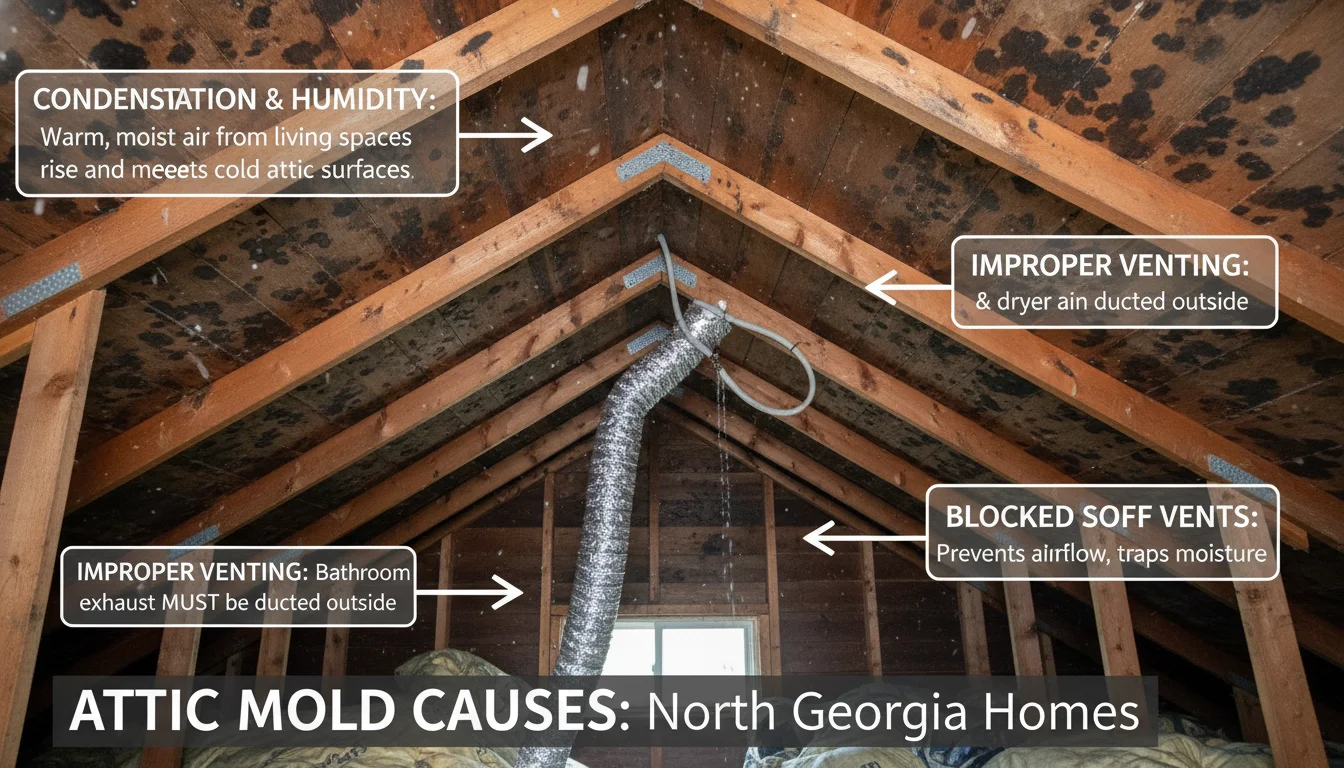
To understand why attic mold is so prevalent in Hall County, you have to understand the unique combination of factors our climate creates. Attic mold requires three things: mold spores (always present), a food source (the wood sheathing and framing is pure mold food), and moisture. The moisture is the variable that turns a normal attic into a mold farm, and North Georgia provides moisture in abundance through several mechanisms.
Poor Attic Ventilation: The Number One Cause
Attic ventilation is designed to do two things: exhaust heat in summer and exhaust moisture in winter. When it fails at either task, condensation forms on the cool underside of the roof deck. In a properly ventilated North Georgia attic, you need roughly one square foot of net free ventilation area for every 150 square feet of attic floor space, split roughly evenly between intake vents (soffit vents) and exhaust vents (ridge vents, gable vents, or roof louvers).
The problem? Many Hall County homes built before 2000 have inadequate ventilation, and even newer homes often have ventilation systems that were compromised after construction. Soffit vents get blocked when homeowners blow in additional insulation without installing baffles. Ridge vents get partially obstructed by debris. Gable vents get covered during siding replacement. And many older Gainesville homes were simply built with insufficient vent area to begin with, reflecting building practices from an era when energy was cheap and building science was less advanced.
Bathroom Exhaust Fans Venting Into the Attic
This problem is so widespread in North Georgia that we encounter it in roughly one out of every three homes we inspect in Hall County. A bathroom exhaust fan that terminates in the attic rather than venting through the roof or a gable end pumps warm, moisture-laden air directly into the attic every time someone showers. A single shower generates approximately one pint of water vapor. Over the course of a year, that's dozens of gallons of water condensing on roof sheathing, insulation, and framing in the immediate vicinity of the fan discharge. The result is localized but often severe mold growth directly above bathrooms.
Check your bathroom exhaust fans today. Go into the attic during daylight hours and trace the duct from each fan. If the duct simply ends in the attic space rather than terminating at a roof cap or wall cap, you've found a major moisture source. Fixing this is one of the highest-return mold prevention investments you can make.
Roof Leaks
Roof leaks are the most obvious cause of attic mold, but they're often not as obvious as homeowners assume. A slow leak around a pipe boot, a cracked vent flashing, or a small section of missing shingles after a Hall County thunderstorm may not produce a visible ceiling stain downstairs. Water can travel along the roof sheathing, down a rafter, and into insulation before it ever shows up on your living room ceiling. By the time you see the stain, mold has been growing in the attic for weeks or months.
After any significant storm — and Hall County sees plenty of them, particularly during spring tornado season and summer thunderstorm season — perform a quick attic inspection with a flashlight. Look for wet spots on the sheathing, water staining, or darkened areas that weren't there before. The roof leak you catch in week one requires a simple repair. The roof leak you discover in month six requires mold remediation plus sheathing replacement.
Insufficient Insulation and Thermal Bridging
When attic insulation is inadequate or unevenly distributed, the ceiling plane becomes colder than the attic air during winter. Warm, moist indoor air that leaks into the attic through ceiling penetrations can condense on cold surfaces — particularly around recessed lights, attic hatches, and plumbing vents that penetrate the ceiling. This condensation feeds mold growth that's often concentrated in patterns reflecting the ceiling penetrations below.
For Georgia's Climate Zone 3A, the Department of Energy recommends attic insulation levels of R-30 to R-60. Most existing Hall County homes fall well below this, particularly older homes with original insulation that has settled, compressed, or been disturbed over decades.
Health Risks of Attic Mold
The health effects of attic mold depend on the species, the spore concentration reaching living spaces, the duration of exposure, and individual sensitivity. Here's what the medical and scientific literature tells us:
Allergic Reactions and Respiratory Irritation
This is the most common health effect and the one most likely to affect the largest number of occupants. Mold spores are potent allergens. When they migrate from the attic into living spaces, they can trigger:
- Nasal congestion, runny nose, and sneezing
- Throat irritation and chronic cough
- Eye irritation, redness, and watery eyes
- Wheezing and shortness of breath, especially in people with asthma
- Skin rashes in sensitive individuals
These symptoms often follow a pattern that should raise suspicion: they're worse in certain rooms (typically upstairs rooms closer to the attic), worse at certain times of year (when temperature and humidity conditions favor mold growth), and improve when occupants leave the home for extended periods.
Asthma Exacerbation
The CDC and the World Health Organization both recognize damp indoor environments and mold as significant asthma triggers. For the roughly 8% of Georgians with asthma, living in a home with attic mold that communicates with living spaces can increase the frequency and severity of asthma attacks. Children, whose respiratory systems are still developing, are particularly vulnerable.
Hypersensitivity Pneumonitis
While less common than allergic reactions, hypersensitivity pneumonitis is a more serious condition involving inflammation of the lung tissue. It occurs in susceptible individuals after prolonged exposure to high concentrations of certain mold antigens. Symptoms include cough, fever, chills, and shortness of breath developing hours after exposure. This condition requires medical diagnosis and treatment, and its primary prevention is eliminating the mold exposure that causes it.
Mycotoxin Concerns
Certain mold species common in water-damaged buildings — including Stachybotrys chartarum (black mold) — produce mycotoxins, toxic chemical compounds that can cause more severe health effects. The scientific community continues to debate the degree to which airborne mycotoxin exposure in residential settings causes illness, but the CDC acknowledges that mold exposure is associated with respiratory symptoms and that people with mold allergies or compromised immune systems are at higher risk. Regardless of where you land on the mycotoxin debate, the presence of toxigenic mold species in a home is undesirable and warrants professional remediation.
Signs You May Have Attic Mold
You don't necessarily have to climb into the attic to suspect a mold problem. These signs, observable from within the living space, often indicate attic mold:
- Musty, earthy odor in upstairs rooms, particularly noticeable when entering the home or after the HVAC has been off. This odor is caused by mVOCs (microbial volatile organic compounds) produced by active mold metabolism.
- Increased allergy or asthma symptoms among household members, especially when the pattern shows symptoms improving away from home.
- Dark staining visible on the underside of roof sheathing when you look into the attic with a flashlight from the access hatch — even without fully entering.
- Water stains on ceilings of the top floor, even if they appear old and dry. Where there was water, there was almost certainly mold behind the drywall.
- Condensation on attic-side insulation, visible when you lift a small section of insulation near the eaves on a cold morning.
- Rust on roofing nails protruding through the sheathing, visible from inside the attic. Rust indicates the nail shank has been wet repeatedly — a proxy indicator for moisture conditions that also support mold.
DIY Attic Inspection: How to Check Safely
You can perform a basic attic inspection yourself, but do it safely:
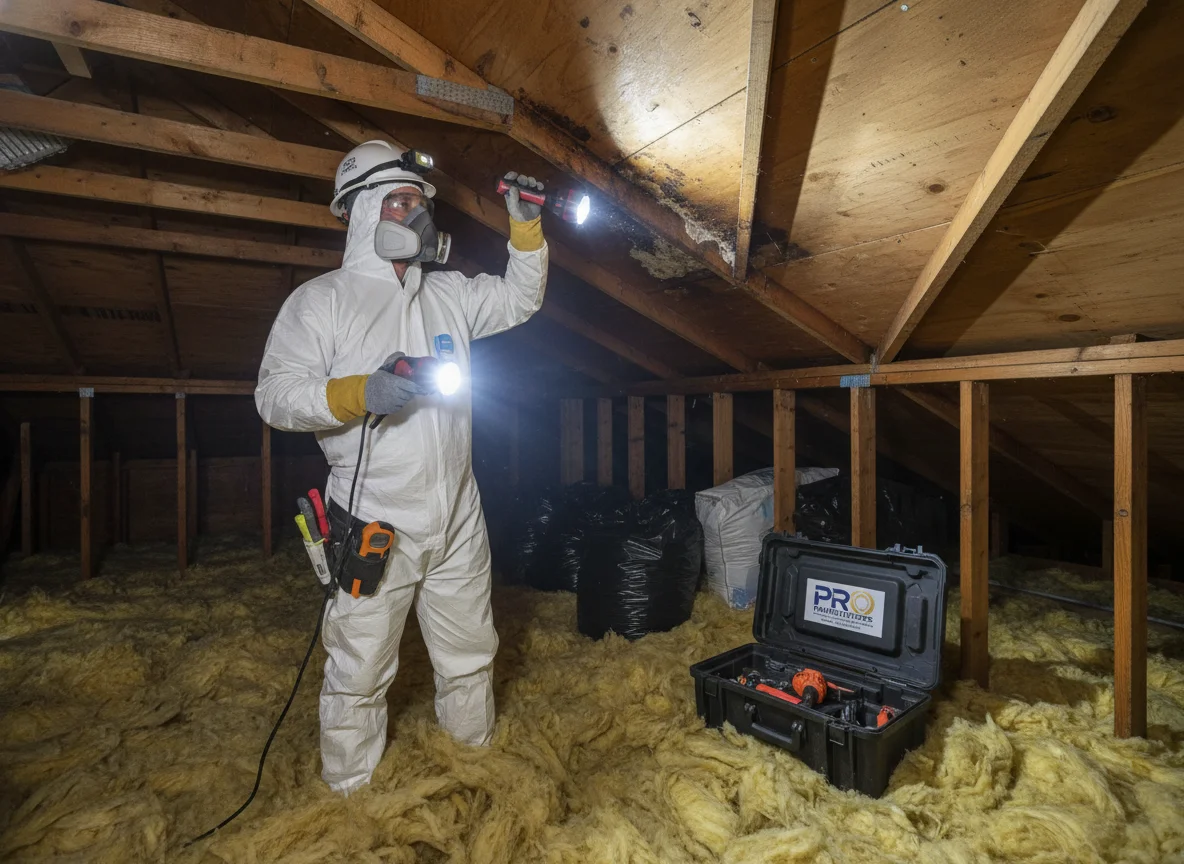
- Wear proper protection. At minimum, an N95 respirator, safety glasses, long sleeves, long pants, and gloves. If you see extensive visible mold, upgrade to a P100 respirator or hire a professional. Do not enter a moldy attic without respiratory protection.
- Bring a bright flashlight. A standard flashlight is adequate; a high-lumen LED work light is better. You need to see the surface texture of the sheathing, not just the general outline.
- Walk only on framing members. Never step on drywall, insulation, or between joists. Falling through a ceiling is a serious injury risk and causes expensive damage. If the attic lacks a floored walkway, lay down a plank or plywood strip to create a stable path.
- Check during or shortly after rain if possible. Active roof leaks are far easier to spot when water is actively entering. Look for wet spots, drips, or shimmering moisture on the sheathing.
- Examine the entire roof deck systematically. Start at the ridge and work your way down to the eaves on each slope. Pay special attention to areas around roof penetrations (plumbing vents, chimney, attic vent fans).
- Document with photographs. Even if you're not sure what you're seeing, photos let you show a professional later without requiring a second trip into the attic.
- Check bathroom fan ducts. Trace each duct to verify it exits the attic space. Look for disconnected duct joints that are dumping moist air into the attic.
The Remediation Approach: Fix the Cause First, Then Fix the Mold
The single biggest mistake in attic mold remediation is treating the mold without fixing the moisture source. You can have the roof sheathing scrubbed, sanded, and sealed to perfection, but if the bathroom fan still vents into the attic or the soffit vents are still blocked, the mold will return. Guaranteed.
Here's the correct sequence for attic mold remediation in a Hall County home:
- Identify and fix the moisture source. This may involve roof repair, bathroom fan ducting correction, adding soffit vent baffles and additional ventilation, air sealing the attic floor to reduce warm moist air leakage from the living space, or a combination of these measures. Until the moisture source is corrected, remediation is temporary.
- Contain the work area. Professional remediation includes sealing the attic access to prevent spores from being distributed into the living space during the cleaning process.
- Remove or treat affected materials. The approach depends on the severity. Light surface mold on sheathing can often be treated with HEPA vacuuming followed by application of an EPA-registered antimicrobial and, optionally, an encapsulant coating. Heavily colonized or water-damaged sheathing should be removed and replaced. Mold-contaminated insulation must be removed and replaced; insulation cannot be effectively cleaned.
- HEPA vacuum and clean. After bulk removal, the entire attic should be HEPA-vacuumed to capture settled spores.
- Post-remediation verification. After the work is complete, surface sampling or air sampling should confirm that spore levels have returned to normal background levels.
For a detailed look at remediation costs for different types of projects, see our mold remediation services page for Gainesville and Hall County, which includes pricing guidance for attic jobs.
Prevention: Keeping Your Attic Mold-Free in North Georgia
Prevention is dramatically cheaper than remediation. Here's what every Hall County homeowner should do:
Ensure Proper Ventilation
Your attic should have a balanced ventilation system with intake at the soffits and exhaust at or near the ridge. If you're unsure whether your ventilation is adequate, have it evaluated. Adding soffit vents, a ridge vent, or supplemental roof louvers is a one-time investment that pays for itself by preventing mold, extending roof life (excess attic heat degrades asphalt shingles from below), and reducing summer cooling costs.
Air Seal the Attic Floor
Every penetration between your living space and the attic — recessed lights, electrical boxes, plumbing vents, attic hatches, interior wall top plates — should be sealed with caulk, foam, or weatherstripping. This prevents warm, moist indoor air from entering the attic in winter, which is a primary driver of condensation mold. Air sealing is the single most cost-effective energy efficiency measure for most homes and simultaneously prevents attic mold.
Maintain Adequate Insulation
Consistent, adequate insulation depth across the entire attic floor keeps the ceiling plane warm enough to prevent condensation. In Hall County, aim for R-38 to R-49 (roughly 12 to 16 inches of blown fiberglass or cellulose). Pay special attention to the perimeter above exterior walls, where insulation depth often tapers and thermal bridging is most pronounced.
Verify Exhaust Fan Termination
Confirm that every bathroom exhaust fan, kitchen range hood, and dryer vent terminates outside the building envelope — through the roof, a gable end, or an exterior wall. None of these should discharge into the attic, the soffit, or the crawlspace.
Annual Attic Inspection
Once a year — ideally in early spring after winter condensation risk has passed and before summer humidity season begins — perform a quick attic walkthrough with a flashlight. Look for new staining, wet spots, or any change from the previous year. Early detection of a small roof leak or a new condensation area is infinitely cheaper than discovering the problem months later when sheathing has become a mold farm.
Found Attic Mold? Don't Ignore It.
Call Mold Remediation Hotline at (332) 220-0303 for a professional attic assessment in Hall County. We identify the moisture source, provide a written remediation plan, and restore your attic to safe condition — with a warranty on the work.
Free attic inspections for Gainesville, Oakwood, Flowery Branch, and all Hall County homeowners. Same-week appointments available.