Air Quality Testing After Mold Removal: Why It Matters in Georgia
You've spent thousands on mold remediation. The containment barriers came down. The musty smell is gone. The walls are rebuilt and painted. But is the air you're breathing actually clean? Without post-remediation verification testing, you're trusting your health to a visual inspection of a process you can't see. Here's why air quality testing after mold removal is not optional in Georgia — it's the only way to confirm the job was done right.
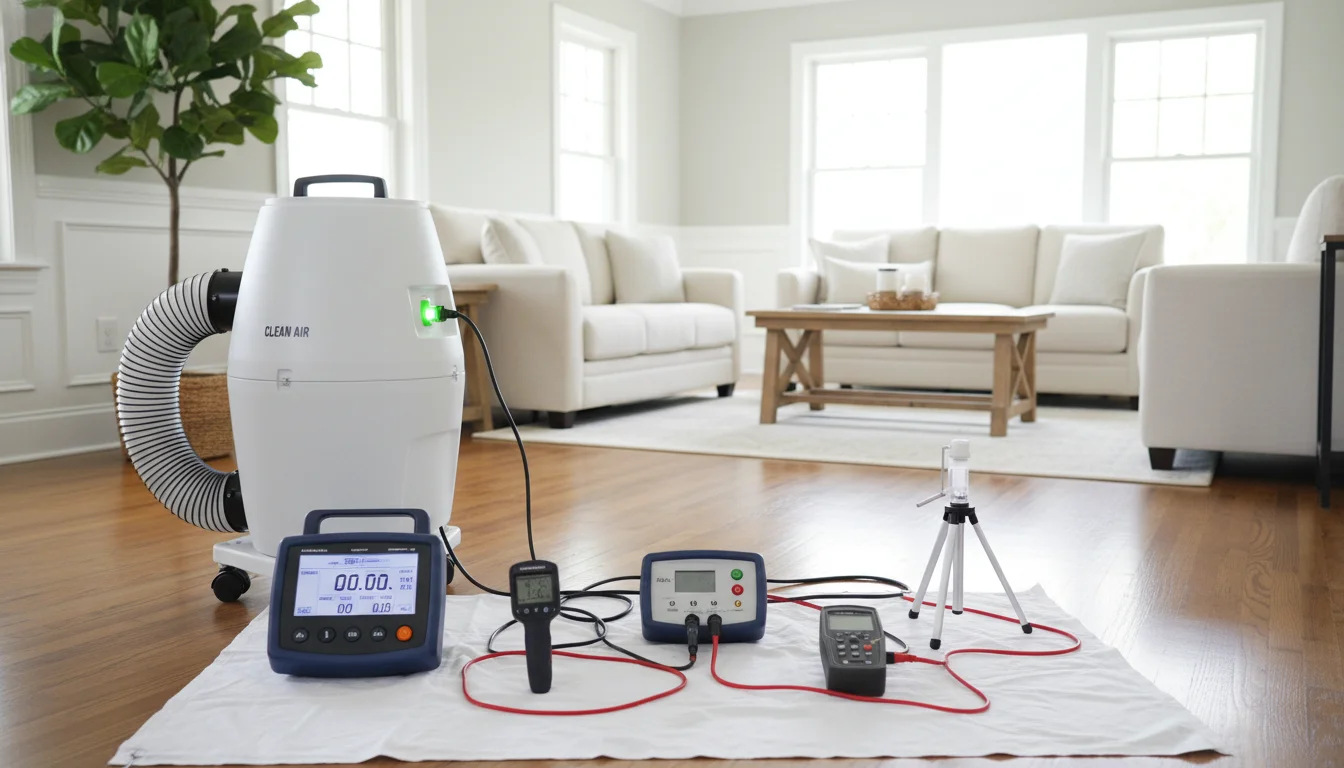
What Is Post-Remediation Verification (PRV) Testing?
Post-remediation verification, often called PRV or clearance testing, is a scientific process that confirms mold spore levels inside a remediated area have returned to normal, acceptable concentrations. It is not the same as the initial mold inspection that identified the problem. PRV testing is specifically designed to answer one question: Did the remediation work?
The IICRC S520 Standard for Professional Mold Remediation, the industry's governing document, states that the final step of any mold remediation project should be verification that the remediation was successful. This is not a suggestion — it is a core element of the professional standard of care. A remediation company that performs work without offering or recommending post-remediation verification is not following the industry standard.
Why PRV Testing Is Essential: Three Reasons
1. It Confirms the Remediation Actually Worked
Mold remediation involves removing contaminated materials, cleaning surfaces, and capturing airborne spores through HEPA air scrubbing. But mold spores are microscopic — individually invisible to the naked eye. A surface can look clean while still harboring millions of spores. Without air quality testing, you cannot know whether air in the remediated area has returned to normal spore levels. The remediation crew might have done everything right, or they might have missed a hidden colony behind a section of drywall they didn't open. Only testing provides the answer.
In one case we reviewed in Hall County, a homeowner paid a contractor $7,500 to remediate a basement after a plumbing leak. The contractor removed visible mold, sprayed an antimicrobial, and left. The homeowner, still experiencing allergy symptoms, ordered independent air quality testing. The test revealed indoor spore counts of 8,400 spores per cubic meter for Aspergillus/Penicillium compared to an outdoor control of 480 spores per cubic meter — a ratio of 17.5:1 indicating continued active mold growth inside. The remediation had failed because the contractor had not removed the drywall on the back side of a closet wall where mold was thriving in the wall cavity. PRV testing caught what a walkthrough missed.
2. It Provides Documentation for Insurance and Real Estate
If you filed an insurance claim for mold or water damage, your insurer may require post-remediation testing before closing the claim or before renewing your policy. Many Georgia homeowners have discovered that their insurer wants independent verification that a covered mold loss was properly resolved before they'll continue to underwrite the property.
In real estate transactions, post-remediation clearance testing is even more critical. If you sell your home after mold remediation, the buyer and the buyer's lender may require documented evidence that the mold was professionally resolved. A seller who remediated mold but cannot produce clearance testing documentation may find the deal in jeopardy. A buyer who discovers mold after closing may review whether proper clearance testing was done as part of establishing a non-disclosure claim. Clearance testing documentation protects both parties. For a comprehensive guide to mold in real estate contexts, see our article on mold disclosure requirements for Georgia home sellers.
3. It Gives You Peace of Mind
This isn't merely psychological. After mold remediation, many homeowners experience ongoing anxiety about whether the problem is truly solved. They notice every musty smell (which might be normal outdoor Georgia humidity), they scrutinize every spot on a wall, and they worry every time a family member sneezes. An independent clearance test replaces anxiety with data. When the lab report shows indoor spore levels consistent with or lower than outdoor levels, and the mold types found indoors are the same types found outdoors (indicating normal infiltration rather than indoor growth), you can breathe easily — literally. You may also want to review our mold remediation cost guide to understand the full investment you're protecting.
Types of Air Quality Tests Used for PRV
Not all air quality tests are the same. Understanding the types helps you evaluate the quality of the testing you receive.
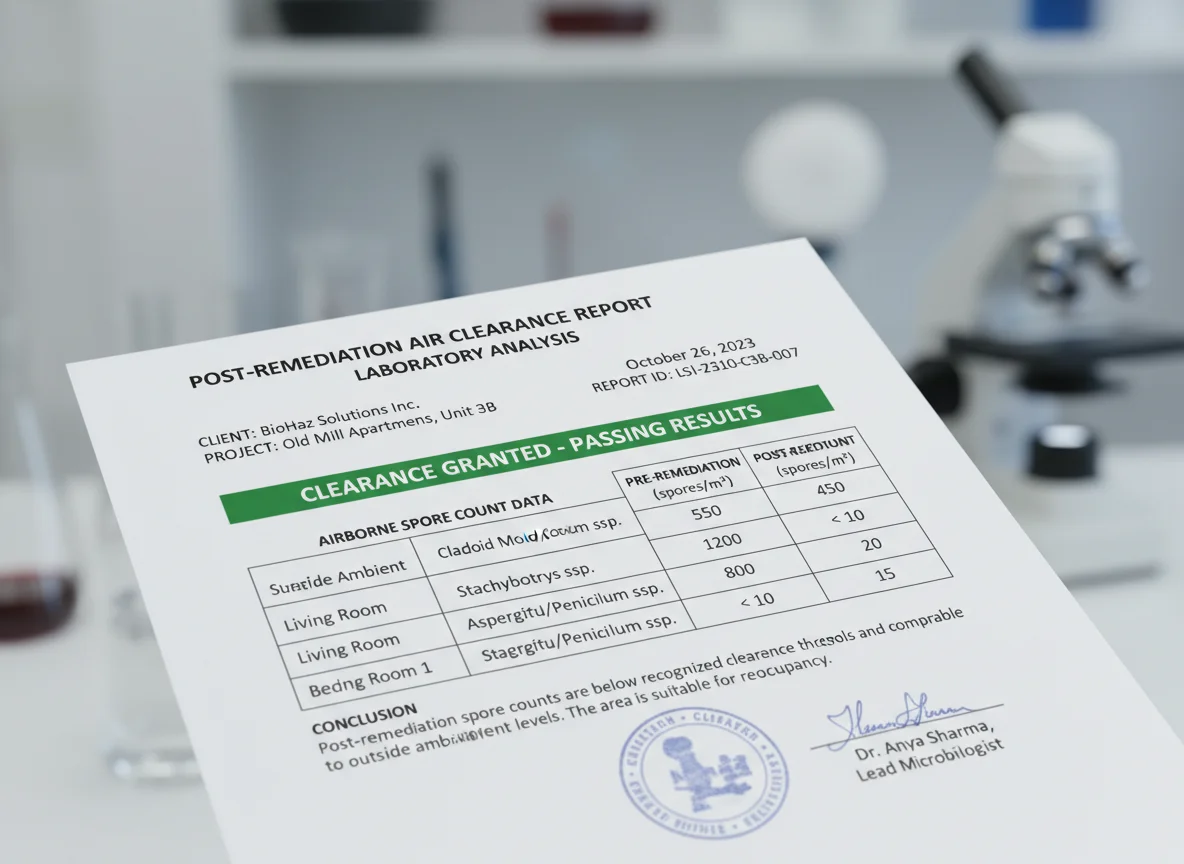
Spore Trap Sampling (Non-Culturable)
This is the most common method for post-remediation verification. A calibrated air pump draws a known volume of air (typically 75 to 150 liters) through a cassette containing a sticky-coated slide. Airborne particles, including mold spores, impact and adhere to the slide. The slide is then examined under a microscope by a laboratory analyst who identifies and counts spores by genus (and sometimes species).
Advantages: Fast turnaround (24-48 hours), identifies both viable and non-viable spores, relatively low cost.
Limitations: Cannot always distinguish between species within a genus, cannot determine whether spores are viable (capable of growing), and some spore types are difficult to identify by microscopy alone.
Culturable Air Sampling
Air is drawn across a petri dish containing a growth medium. The dish is incubated in a laboratory, and any mold colonies that grow are counted and identified to the species level. Results are reported as colony-forming units (CFU) per cubic meter of air.
Advantages: Identifies mold to the species level (including whether Stachybotrys chartarum specifically is present, not just Stachybotrys genus), confirms spore viability (only living spores grow), and provides more detailed identification than spore traps.
Limitations: Longer turnaround (7-10 days), higher cost, only detects viable spores (dead spores from a successfully remediated area won't grow, which is actually a limitation for PRV purposes because you want to know if any spores — viable or not — remain elevated).
Particle Counting
A laser particle counter measures the number and size distribution of airborne particles in real time. This is not a mold-specific test — it counts all particles, including dust, skin cells, and fibers. However, it can be useful as a comparative tool: particle counts inside the remediated area are compared to particle counts in a control area of the home and to outdoor levels. If the remediated area shows dramatically higher particle counts, further investigation is warranted.
For post-remediation verification purposes, spore trap sampling is the standard method. It provides the right balance of speed, cost, and actionable information. Culturable sampling may be added when species-level identification is medically or legally important. For more on testing methods used during the initial investigation, read our mold inspection services overview.
What "Normal" vs. "Elevated" Mold Spore Counts Look Like
Interpreting mold spore counts requires context. There is no single national standard for "acceptable" indoor mold levels, because outdoor levels vary dramatically by season, geography, and weather. Instead, the industry standard is to compare indoor samples to an outdoor control sample taken at the same time. Here's a general framework:
| Condition | Interpretation |
|---|---|
| Indoor spore count similar to or lower than outdoor count, same spore types | Normal conditions. Spores indoors reflect normal infiltration from outdoors. |
| Indoor spore count moderately higher than outdoor (2-5x), or spore types present indoors that are absent outdoors | Possible indoor amplification. Further investigation warranted. Might indicate a small residual source. |
| Indoor spore count significantly higher than outdoor (5-10x or more) | Probable indoor mold amplification. Remediation was incomplete or a new problem has developed. Requires re-evaluation and additional remediation. |
| Presence of indicator species indoors (Stachybotrys, Chaetomium, Ulocladium) at any elevated level, especially when absent outdoors | These "water-damage indicator" mold types are rarely found in normal outdoor air at significant levels. Their presence indoors strongly suggests chronic water damage and active mold growth inside. |
Absolute spore counts matter too, but they must be interpreted with seasonal and geographic context. In North Georgia during summer, outdoor total spore counts of 5,000-20,000 spores per cubic meter are common. An indoor count of 2,500 spores per cubic meter in July might be perfectly normal if the outdoor control was 8,000. The same indoor count of 2,500 in January, when outdoor levels might be 300, would be highly abnormal and indicate indoor amplification.
When to Do Clearance Testing
Timing matters. Perform post-remediation verification testing 48 to 72 hours after remediation work is complete. This window allows:
- Any spores stirred up during the remediation process to settle or be captured by the HEPA air scrubbers that should have run during and after the work.
- The air in the remediated area to reach equilibrium with the rest of the home.
- Enough time for any residual moisture from the remediation cleaning process to dry. Testing while surfaces are still damp from antimicrobial application may produce misleading results.
- The home's HVAC system, if it was shut down during remediation, to resume normal operation and equalize conditions throughout the house.
Testing too soon after remediation (within 24 hours) risks capturing remediation-related airborne debris that doesn't represent the long-term condition of the space. Testing too late (beyond a week) leaves too much time for new problems to develop, complicating the question of whether issues found are residual from the original problem or new issues unrelated to the remediation.
Georgia Humidity and Its Effect on Air Quality Testing
North Georgia's humidity creates unique considerations for post-remediation air quality testing that don't apply in drier climates:
Elevated Outdoor Baselines
Georgia's warm, humid climate supports robust outdoor mold populations. During spring, summer, and fall, outdoor spore levels in Hall County routinely reach 10,000-50,000+ total spores per cubic meter, particularly after rain events or during periods of high humidity. A clearance test showing 3,000 spores per cubic meter indoors might alarm a homeowner who doesn't realize the outdoor control reading was 12,000. The ratio matters more than the absolute number. This is why comparing indoor to outdoor samples drawn simultaneously is non-negotiable for accurate interpretation.
Humidity Confounding
If the remediated area is not properly dried before testing, residual elevated humidity can support spore germination or prevent airborne spore levels from normalizing. The remediated area should have a relative humidity below 60% before clearance testing is performed. In Georgia summers, this may require running a dehumidifier in the remediated area for several days before testing, even if no active moisture source remains. Humidity alone, without any active leak or water intrusion, can keep spore counts elevated if it remains above 60%.
Seasonal Variation
Air quality testing results are inherently seasonal. A clearance test performed in January, when outdoor spore levels are naturally low, should show very low indoor levels. The same space tested in July with the same successful remediation might show higher indoor counts simply because outdoor levels are higher and more spores are infiltrating through normal ventilation. When comparing multiple clearance tests over time, always compare them to their respective outdoor controls, not to each other as absolute numbers.
How to Read a Mold Air Quality Report
When you receive your post-remediation verification report, focus on these key sections:
- Sample summary table. Look for the column showing spores per cubic meter for each sample location. The indoor sample(s) should show counts that are equal to or lower than the outdoor control for each spore type.
- Spore types identified. The same types should appear indoors and outdoors in similar proportions. If a spore type appears indoors that is completely absent from the outdoor sample, that's a red flag suggesting an indoor source.
- Water damage indicator species. Check specifically for Stachybotrys, Chaetomium, Ulocladium, and Memnoniella. If any of these appear in the indoor sample at levels significantly above the outdoor control, the remediation may not have been complete.
- Analyst's interpretation. Most lab reports include a narrative interpretation section where the analyst flags any conditions of concern. Read this carefully.
- Sample volume and detection limit. Verify the air pump drew adequate volume (typically 75-150 liters for a 5-10 minute sample). Low sample volume reduces statistical reliability.
Cost of Air Quality Testing in Georgia
In the Hall County market, post-remediation air quality testing typically costs:
- Individual spore trap air sample (including lab analysis): $75-$150 per sample. A basic clearance test uses one outdoor control plus one or two indoor samples, totaling $225-$450.
- Surface sample (tape lift or swab): $75-$125 per sample.
- Culturable air sample: $100-$175 per sample, plus longer lab turnaround.
- Full PRV package (inspection, two indoor spore traps, one outdoor control, written report): $350-$550 in the Gainesville area.
This cost is a small fraction of the remediation cost itself and represents inexpensive insurance that your remediation investment was well spent. Compare $400 for clearance testing to the potential cost of an incomplete remediation that allows mold to regrow, requiring a second remediation project at full cost.
Choosing the Right Tester: Independence Matters
Perhaps the most important decision in post-remediation verification is who performs the testing. The entity that performs the air quality testing should not be the same entity that performed the remediation. This is a fundamental conflict of interest. A remediation company that tests its own work has an incentive to produce "passing" results, consciously or unconsciously. Even well-intentioned companies may interpret borderline results in their favor when they have a financial stake in the outcome.
The industry best practice, and the approach we recommend at Mold Remediation Hotline, is independent third-party clearance testing. The remediation company completes the remediation. Then, an independent certified mold inspector — who has no financial relationship with the remediation company — performs the clearance testing and provides results directly to the homeowner. This separation ensures the homeowner receives an unbiased assessment. Call (332) 220-0303 to be connected with independent mold testing professionals serving Hall County who have no financial stake in your remediation outcome.
Get Independent Post-Remediation Testing in Hall County
Call Mold Remediation Hotline at (332) 220-0303. We connect you with certified, independent air quality testers who verify your remediation was done right — with no conflict of interest. Your health deserves objective data.
Serving Gainesville, Oakwood, Flowery Branch, and all Hall County communities. Clearance testing available 7 days a week.