Flooded Basement: Who to Call First — The 60-Minute Playbook
By Mold Remediation Hotline · May 8, 2026
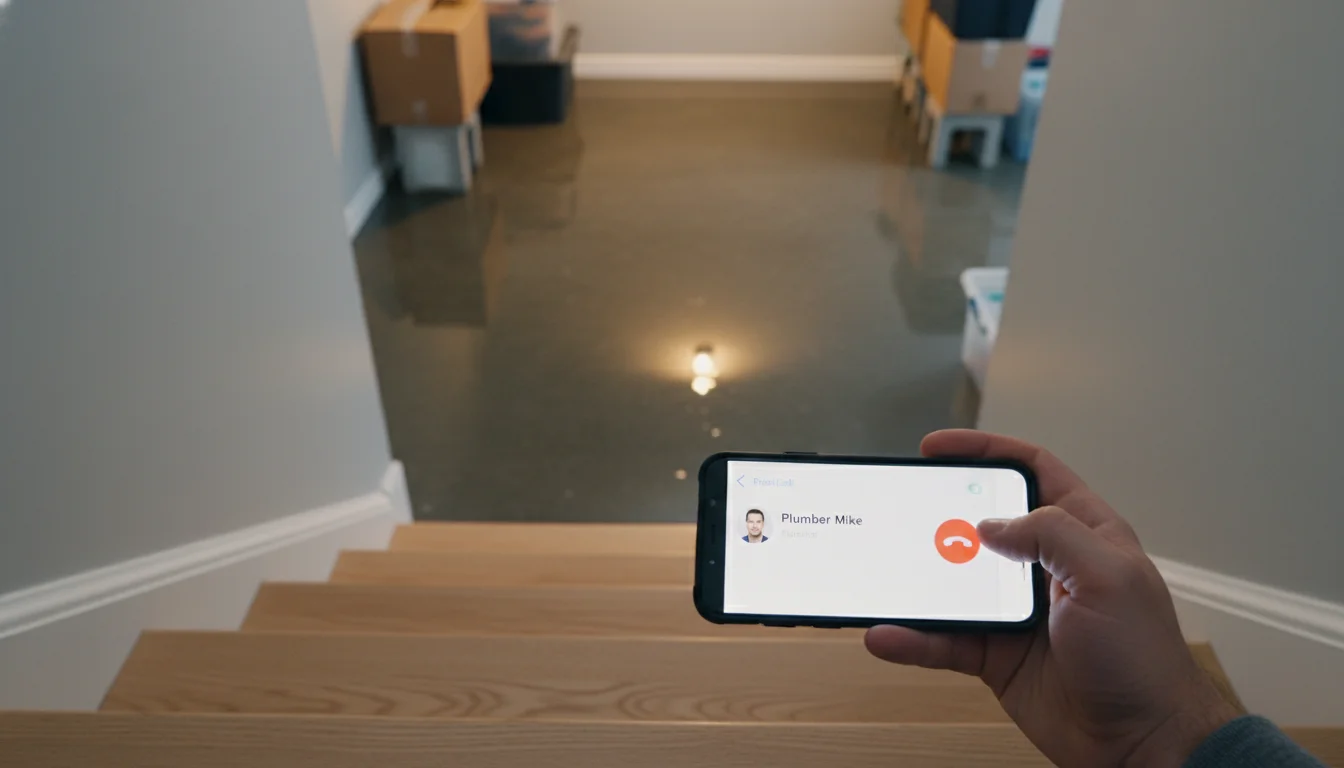
"My basement is flooded — what do I do?" is one of the fastest-rising panic searches in the country right now. Search interest in flooded basement cleanup is up 450% in the last month. The long-tail variants surfacing alongside it — "flooded basement who to call," "flooded basement what to do," "my basement flooded what do i do," "basement flooded who to call" — share a common shape: a homeowner standing at the top of a basement stairwell at 2 AM, water below the bottom step, asking what to do in what order. The 60-minute playbook below is structured exactly that way: who to call, in what sequence, and what to do while you wait.
Basement flooded right now? Skip the search results — talk to a remediation specialist.
Call (332) 220-0303 — 24/7 nationwide.
Minute 0-5: who to call FIRST depends on what you see
Different first calls for different scenarios. Get this right and the rest of the hour falls into place.
- You smell gas, see sparks, or hear electrical popping: Call 911 first. Do not enter the basement.
- You see active water gushing from a pipe or appliance: Call your municipal water utility for an emergency main shutoff if you cannot find or operate yours, OR shut off the main yourself if you can.
- Standing water with no visible electrical/gas hazard, no active gushing source: Call a 24/7 water damage cleanup company — they answer overnight and dispatch within hours, which is faster than waiting for sunrise to start drying.
- You are inside a declared disaster zone (storm, hurricane, tornado): Call cleanup first, then register at DisasterAssistance.gov for FEMA aid. Aid registration takes 10 minutes and runs in parallel with cleanup; it does not replace it.
Notice what's NOT on this list: your insurance company. Insurance is call #2 or #3, not call #1. The first hour is about stopping the damage from getting worse. Insurance assesses what already happened.
Minute 5-15: cut power, take photos, do not enter the water yet
- Find your electrical breaker box. If it is in the basement and the basement has standing water, do not enter. Call an electrician or your utility; the brief delay is worth not getting electrocuted.
- Cut power to the affected area at the breaker. Trip the main if individual basement breakers are not labeled.
- Photograph everything from the top of the stairs first. Wide shot of the standing water, the visible furniture, walls. Date-stamped phone photos taken before you enter the space are insurance gold later.
- Do NOT enter the basement until power is confirmed off and gas is confirmed safe. The pull to start cleanup immediately is strong. Resist it for the 15 minutes it takes to make the space safe.
Minute 15-30: the water source decides everything that follows
Where is the water coming from? The answer changes which professionals you need and what your insurance will cover.
- Burst pipe / failed supply line (clean water): a "Category 1" water loss. Cleanup is straightforward, insurance coverage is typical, mold risk is moderate.
- Failed water heater or appliance (clean water at first, becomes "Category 2" after 48 hours): same cleanup approach, slightly elevated mold risk after 48 hours wet.
- Sewer backup or toilet overflow ("Category 3" / black water): hazardous; requires professional remediation, full PPE, and disposal of all porous contacted materials. Do not DIY.
- Groundwater intrusion / storm-driven flooding (also "Category 3" because it carries soil/biological contaminants): same as sewer backup — call professionals, do not save the carpet.
- Sump pump failure with otherwise clean water: usually Category 2; cleanup approach depends on how long the water sat.
If you can identify the source from the top of the stairs (visible burst pipe, water heater geyser, sewer odor), do that before calling. The first question every cleanup company asks is "what's the source" — having the answer ready cuts triage time meaningfully.
Minute 30-45: the cleanup company call (what to ask)
When you call a flooded basement cleanup company, get specific in the first 90 seconds:
- "How fast can you get someone here?" — for active flooding, "within 2 hours" is the standard for 24/7 services. Anything longer and you should keep calling.
- "Do you separate cleanup and restoration into two invoices?" — this matters for insurance and FEMA documentation; if they say "everything is one bill at the end," call somewhere else.
- "What is your water category assessment?" — they will categorize the loss as 1, 2, or 3 on arrival; getting their pre-arrival opinion helps you set insurance expectations.
- "Do you bring extraction equipment on the first visit?" — yes is the only acceptable answer. Some companies do an inspection-only first visit; that's a wasted hour.
As the team at Mold Remediation Hotline regularly sees, the homeowners who recover fastest are the ones who treat the first 60 minutes as a triage exercise — make the right call, ask the right questions, take the right photos — rather than as a race to start mopping. The cleanup happens once professionals arrive; what you do before they arrive determines how expensive the repair gets.
Got the source identified and water still rising? Skip the search results.
Call (332) 220-0303 — 24/7 nationwide remediation specialists.
Minute 45-60: while you wait for help
- Move what you can to higher ground. From the top of the stairs if the basement isn't safe to enter; into the basement only after power is off. Photo albums, electronics, vital documents, anything porous.
- Document the source. If it's a burst pipe, photograph it close. If it's groundwater, photograph the entry point. Source documentation drives the insurance category and coverage outcome.
- Call your insurance company. Now — not tomorrow. Most policies require notification within 24 hours, and same-day calls land in shorter adjuster queues than next-morning calls.
- Open a claim file. Get the claim number in writing. Save every email and text from this point forward.
- Stage drying equipment from upstairs. Box fans pointed down the stairs, dehumidifier near the basement door (running upstairs), towels at the bottom step — anything that starts moving air through the space the moment professionals say it's safe.
What NOT to do in the first hour
- Do not enter standing water with the power on. Period.
- Do not throw anything away yet. Photograph it, move it, but don't dispose. Insurance and FEMA reviewers want to see what was lost; piles to be discarded are evidence.
- Do not bleach surfaces in the first hour. Bleach masks evidence and complicates the cleanup company's water category assessment.
- Do not start tearing out drywall. The cleanup company will mark a clean cut line; pre-emptive demolition is a frequent reason claims partially deny later.
- Do not wait for the insurance adjuster before starting cleanup. Most policies require you to mitigate further damage. Waiting reduces what insurance pays, not the reverse.
FAQ
- My basement is flooded — who do I call first?
- If there's any electrical or gas hazard, 911. If water is actively gushing, your municipal water utility or your own main shutoff. Otherwise, a 24/7 water damage cleanup company. Insurance is call #2 or #3, not call #1.
- How long do I have before mold starts in a flooded basement?
- 24 to 48 hours from when porous materials make contact with standing water. The first 24-hour window is the most important. Past 72 hours, the cleanup conversation usually becomes a mold remediation conversation.
- Can I clean up a flooded basement myself?
- Category 1 (clean water from a burst pipe, less than an inch, hard surfaces only) — yes, with shop-vac and dehumidifier. Category 2 or 3 (any sewer involvement, groundwater, water that's been sitting more than 48 hours) — no. Call professionals; the bacterial and mold risks are not DIY-appropriate.
- Should I call my insurance company before or after the cleanup company?
- After the cleanup company, but within the same hour. Mitigation calls come first because they stop further damage; insurance comes second because they document what already happened.
- What is the difference between flooded basement cleanup and flooded basement restoration?
- Cleanup is the immediate water removal, drying, and disposal of unsalvageable materials in the first 72 hours. Restoration is the structural rebuild that follows — drywall, flooring, mold remediation, paint. Both insurance and FEMA pay differently for each, so keeping them as separate documented projects matters for recovery.
- How much does flooded basement cleanup cost?
- Highly variable. A clean-water Category 1 cleanup of a few hundred square feet typically runs $1,500-$5,000. A Category 3 (groundwater or sewer) cleanup with mold remediation routinely exceeds $20,000. The two biggest cost drivers are how fast you started drying and what category of water was involved.
Standing at the top of the stairs looking at water? Don't keep scrolling — call now.
Call (332) 220-0303 — 24/7 nationwide.